October 13, 2026
Great Lakes Benefits & Wealth Management has been named a 2026 BBB Torch Award for Ethics winner by the BBB of Northwest Ohio & Southeast Michigan. We’re honored, and we’re grateful to the clients who trust us with their families’ finances.
The Torch Awards recognize businesses and nonprofits for ethics, integrity and trust in the way they treat customers, employees and communities. Organizations are nominated, then apply and are evaluated on four areas: character, culture, customers and community.
“I started in this business in 1995, and I’ve learned that a plan is only as good as your trust in the person who built it. Sometimes the right answer doesn’t make us a dime. I would rather tell you that at the kitchen table than have you figure it out years later. That’s what ‘anchored in family values’ looks like on a Tuesday afternoon.” – Wayne K. Maslyk Jr., CFP®, Founder and President
An award with “ethics” in the name made us ask what the word means in our office. Here’s where we landed.
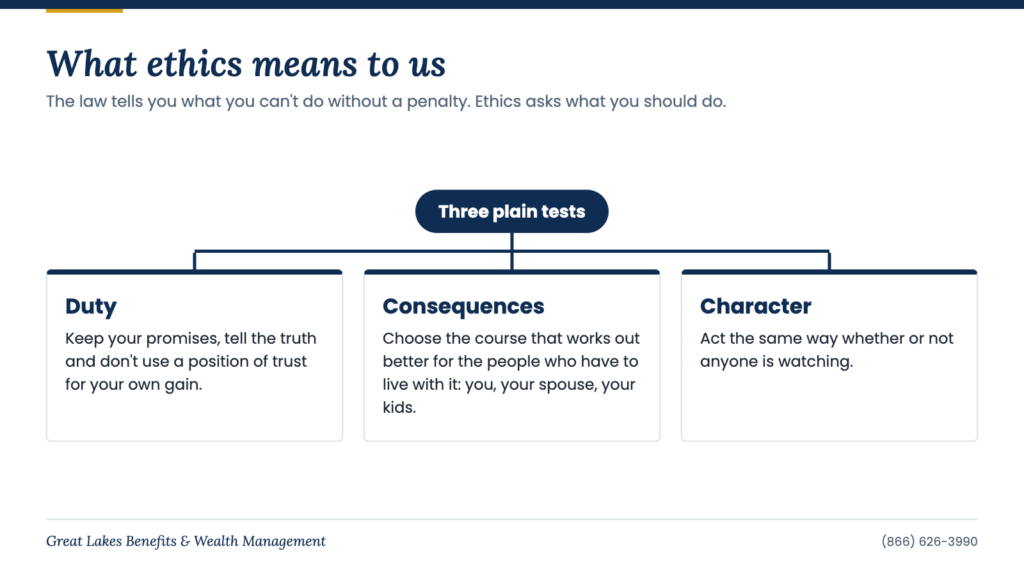
The law tells you what you can’t do without a penalty. Ethics asks what you should do when several legal options are on the table and one of them helps you at someone else’s expense. In financial planning, that question comes up more often than you might think.
We come back to three plain tests:
We hold ourselves to two sets of written standards, and each asks a different question.
The first comes from the BBB, which has accredited Great Lakes Benefits since 2008. Accreditation is voluntary and fee-based, and it centers on trust in the marketplace. Its eight Standards for Trust ask: Do you advertise honestly? Tell the truth? Disclose what affects a buying decision? Honor your promises? Respond to problems? Protect private information?
The second comes from CFP Board. Wayne and Andrew both hold the CERTIFIED FINANCIAL PLANNER™ mark, and keeping it means following CFP Board’s Code of Ethics and Standards of Conduct. Whenever a CFP® professional gives financial advice, that professional must act as a fiduciary, which means acting in the client’s best interests.
That’s a higher bar than selling something honestly. An honest recommendation can still be the wrong one for you. CFP Board breaks the fiduciary duty into three parts, and violations can bring public censure, suspension or loss of the mark.
Here is how those three duties show up when you sit down with us.
Duty of Loyalty: your interests come before ours. A firm paid a percentage of the assets it manages earns more when you move more money to it. That’s a real conflict, and a fiduciary has to avoid it or disclose it, get your informed consent and manage it. Disclosure alone doesn’t satisfy the duty. Our Form ADV spells out how we’re paid, and we’re happy to walk you through it.
Duty of Care: your advice fits your life. A 62-year-old retired teacher and a 29-year-old with student loans shouldn’t get the same answer. The standard stays the same, but the advice changes with your goals, your risk tolerance and your circumstances. That’s why the GLB Way starts with a snapshot of your situation and a conversation about your goals, before any Action Plan.
Duty to Follow Client Instructions: it’s your money. Say you want to keep more cash in the bank than the math suggests. We call that your Happy Number. We’ll show you what it may cost you in lost growth. If your direction is reasonable and lawful, we’ll follow it.
Our ethics also show up in what we won’t do. We don’t draft legal documents, so we work alongside attorneys. We don’t use crypto or private funds in the portfolios we manage. And if you aren’t ready for a planner, we’ll tell you.
“People my age have been sold to plenty when it comes to money. Not many have heard someone say, ‘You don’t need a planner yet. Pay off the credit card first.’ We’ll say that when it’s true. I earned my CFP® mark this year, and to me, that’s the job: give you the honest answer, even when it isn’t the one that brings you in the door.” – Andrew Brewer, CFP®, Financial Planner
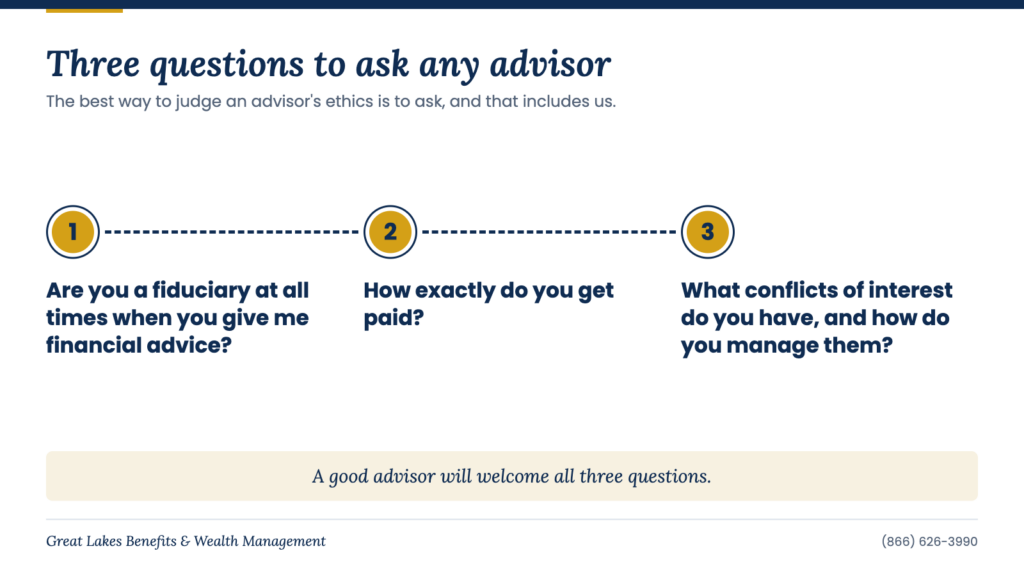
The best way to judge an advisor’s ethics is to ask, and that includes us:
A good advisor will welcome all three questions.
Thank you to the BBB of Northwest Ohio & Southeast Michigan, to Kristin and Alicia, who set the tone for how every client is treated, and to the families across Northern Ohio and Florida’s Pinellas coast who let us be part of their plans.
If you’d like to get your financial house in order, or you just want to ask us those three questions, schedule a complimentary meeting by phone, by video or in our office. Call (866) 626-3990 or contact us.
Wayne and Andrew
GREAT LAKES BENEFITS, INC. owns this website and provides SEC-registered investment advisory services. Registration does not imply SEC endorsement. This site offers general information, not personalized advice. Opinions are current as of posting and may change. Accuracy or timeliness of the content is not guaranteed. Past performance is not a predictor of future results. Consult your own legal or tax advisors before making decisions. Investing involves risks, including potential loss. No strategy ensures profit or prevents loss.
© Great Lakes Benefits Inc. ALL RIGHTS RESERVED. 2026. Privacy Policy | Disclosure . Powered by DevQ