
An old 401(k) is a lot like a boat left at a marina you stopped visiting. It’s still there. It’s probably fine. But nobody is checking on it.
When you leave a job, your 401(k) stays invested exactly how it was on your last day. Nobody adjusts it or asks if it still fits your life. A rollover puts it back where someone is paying attention. Most of the time that’s the right call. Sometimes it isn’t, and we’ll show you how to tell.
What Is a 401(k) Rollover?
A rollover moves your retirement money from an old employer’s plan into a new account, without taxes or penalties. Think of it like forwarding your mail after a move. The money changes addresses. Nothing else about it changes.
Most people roll into an IRA, an individual retirement account you own instead of your employer. Pre-tax money goes into a traditional IRA. Roth money goes into a Roth IRA.
What Are Your Options for an Old 401(k)?
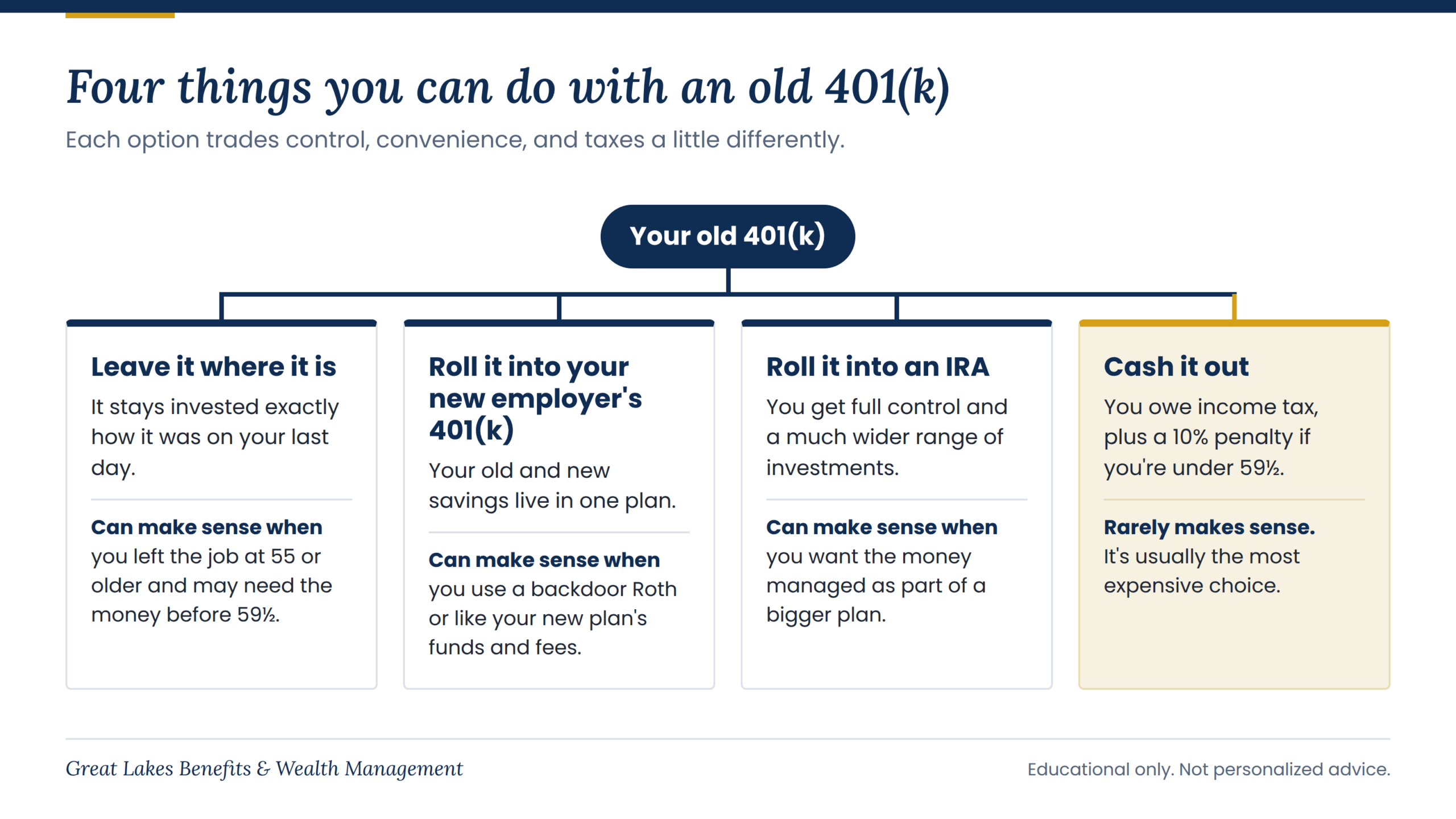
You have four choices. Leave it, move it into your new job’s 401(k), roll it into an IRA, or cash it out. Cashing out is usually the most expensive, because you pay income tax and often a penalty if you’re under 59½.
What Happens if You Leave It Behind?
Old accounts don’t always stay put. Under current rules, a plan can move small balances (currently up to $7,000) into an outside account without asking you, or simply mail you a check. Those outside accounts often sit in cash and charge fees. We’ve seen people lose track of money this way for years.
Can’t find an old plan? Start with an old statement or your former employer’s HR team. The U.S. Department of Labor also offers a free Retirement Savings Lost and Found search.
How Does a Rollover Work at GLB?
It’s mostly paperwork and one phone call. We open your new account, get on the phone with your old provider alongside you, and handle the check if one shows up. You don’t have to figure it out alone.

What’s the Biggest Rollover Mistake?
Letting the check be made out to you.
If your old plan writes the check in your name, it has to hold back 20% for taxes. A $50,000 account becomes a $40,000 check. You then have 60 days to deposit the full $50,000, which means covering the missing $10,000 yourself. You get it back at tax time, but only if you replaced it. Anything you don’t deposit in time counts as a withdrawal, so it’s taxed and possibly penalized.
The fix is easy. Ask for a direct rollover, with the check made out to your new account for your benefit. Nothing gets held back. If that check lands in your mailbox, just drop it off at our office.
When Should You Leave Your 401(k) Where It Is?
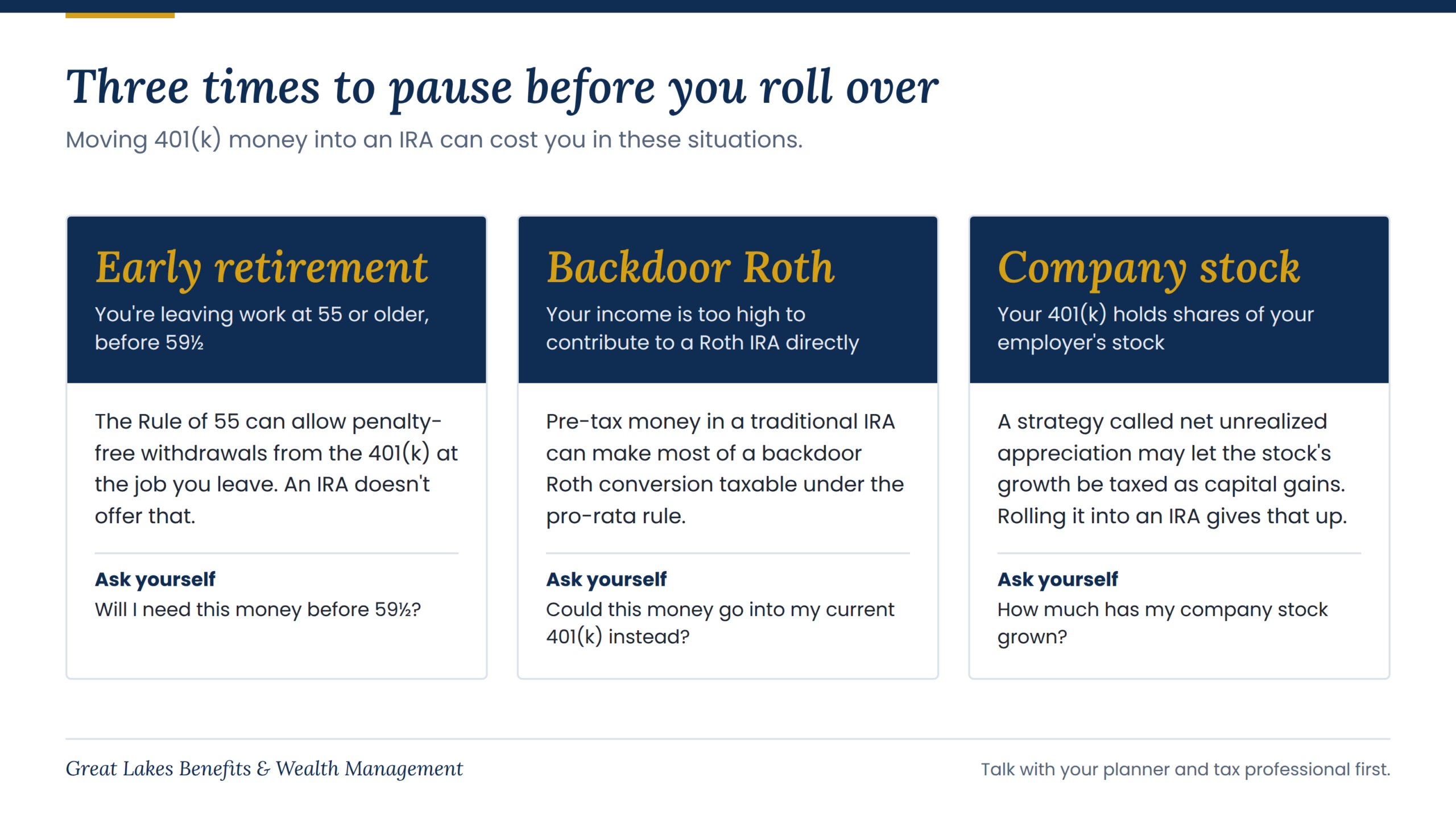
A rollover isn’t always the right move. Pause if any of these fit you.
You’re retiring between 55 and 59½. Your 401(k) may let you take withdrawals without a penalty under the Rule of 55. An IRA makes you wait until 59½.
You use a backdoor Roth. Pre-tax money sitting in an IRA can make most of that conversion taxable. Moving the old 401(k) into your current employer’s plan can avoid the problem.
You own company stock in your 401(k). A tax strategy called net unrealized appreciation may let that stock’s growth be taxed at capital gains rates instead of income rates. Rolling it into an IRA gives that up.
We check all three before we move a dollar.
Why Not Just Roll It Over Yourself?
You can. Moving it to your own account and picking a target-date fund is a reasonable choice for some people.
What you get with us is the rest of the picture. If you’re close to retirement, that 401(k) is probably a big pre-tax bucket that has never been taxed, and how you draw that money out matters as much as how it’s invested. Our team is led by CERTIFIED FINANCIAL PLANNER™ professionals who tie your rollover into your tax planning and give you a second set of eyes when life changes. Self-employed? We work with solo 401(k)s, SEP IRAs, and SIMPLE IRAs too.
We won’t promise lower fees. Every investment has costs, and most 401(k) fees are built into the funds. Your plan’s annual fee disclosure shows what you’re paying now.
What Should You Do First?
Find your last statement or log in to the old account. See what it’s invested in. Then make one call.
Bring your old statements to a meeting and we’ll tell you whether to roll it over or leave it alone. Schedule a meeting with our team or call (866) 626-3990.