
November 16, 2026
If something happened to your parents tonight, could you find the will, the accounts, and the passwords by tomorrow? For a lot of families, it’s a coin flip.
Most people think the hard part is getting the estate plan done. It isn’t. The hard part is the week after something happens, when the family is grieving and nobody knows which bank Mom used, where the will is, or who’s supposed to make the call at the hospital. With the families I work with, it’s about 50/50 whether the kids actually know where this stuff is. The fix isn’t complicated. It’s one organized place and one conversation.
Start with who’s in charge. If your parent is still alive but can’t speak for themselves, the family needs the financial power of attorney and the healthcare power of attorney before anything else. After that comes their final wishes, their estate documents (a will or a trust), and a list of every account they have.
| What to find | Why it matters | When you’ll need it |
|---|---|---|
| Financial and healthcare powers of attorney | Names who can make decisions for Mom or Dad | A hospital stay or any time they can’t respond |
| Health care directive | DNR and life support wishes, so nobody is guessing | In the hospital |
| Will or trust | Who gets what, and who handles it | After they pass |
| Final wishes | Burial or cremation, the kind of service they want | The first few days |
| A list of every account | Banks, CDs, retirement accounts, insurance | Paying bills and settling the estate |
| Logins and phone access | Online accounts, a password manager, crypto | Both situations |
| Bills and how they’re paid | What comes out on the 5th, what’s paid by dropping off a check | The first month |
Passwords are the one people skip. Nobody wants to snoop through their parents’ computer. But if Dad’s laid up and an account needs attention, being locked out makes everything harder. If your parents use a password manager, they can keep the master code in their safe.
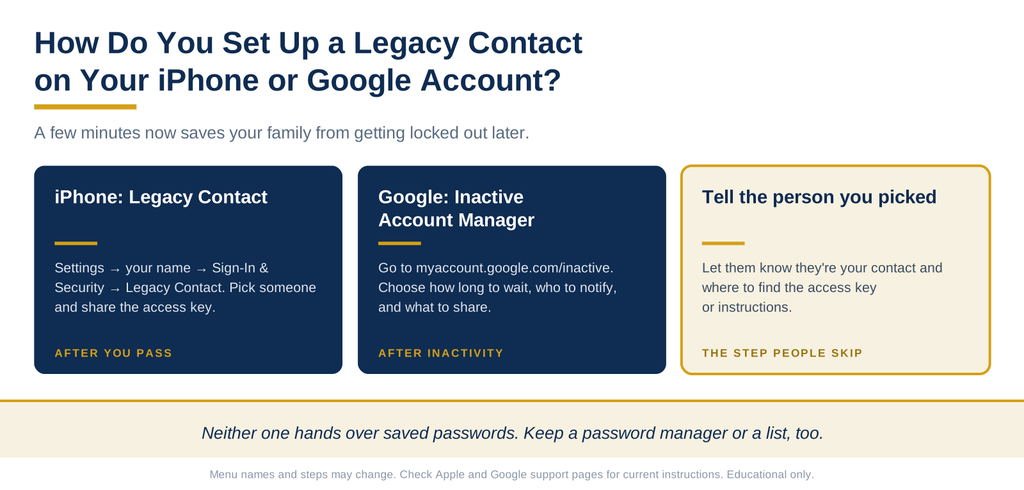
Your phone and email are worth a few minutes, too. On an iPhone, go to Settings, tap your name, then Sign-In & Security, then Legacy Contact. You choose someone, and Apple gives you an access key to share with them. After you pass, they can use that key plus a death certificate to get to your photos, messages, notes, and files. It doesn’t hand over your saved passwords, so you still need a password manager or a list. If you use Gmail, Google has something similar called Inactive Account Manager at myaccount.google.com/inactive. You pick how long your account can go unused, and you pick who Google contacts when that time is up. You can share everything or only certain things. Set one up, or both, and tell the person you picked. A key nobody knows about doesn’t help anyone.
It looks like a treasure hunt during the worst week of your life. Families come in with no idea where to start. One mom had a stack of savings bonds that her kids kept finding in different places around the house. They still don’t know if they found all of them.
Another family knew their mom had one bank. Then they remembered she’d once mentioned a CD at a different bank down the road. Is it still there? Nobody knew. A simple balance sheet listing every account would have answered that in a minute.
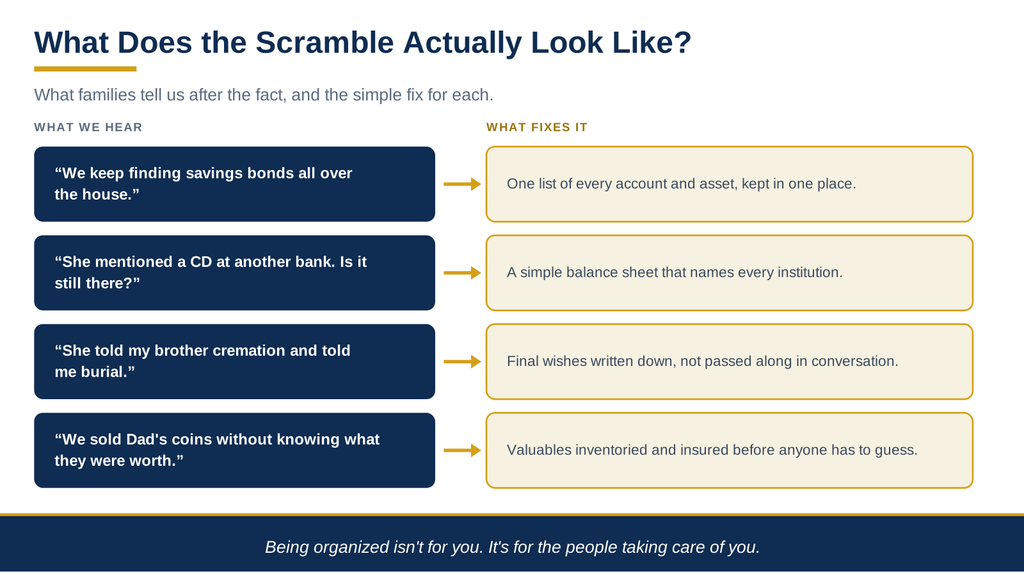
Then there are the arguments. Mom told one sibling she wanted to be buried. She told the other she wanted to be cremated. Now two grieving people have to fight about it. Money and last wishes are some of the fastest ways to put friction between family members, and most of it is avoidable.
You probably don’t need a binder. If your estate documents are done and your family knows where to find them, that’s usually enough. Many will and trust packages include a section where you can write down your final wishes. If yours doesn’t, type up a page or even write it on a legal pad.
Add a one-page list of your accounts, like a simple balance sheet: each bank, each retirement account, each policy, and roughly what’s in it. The format matters less than two things. It’s all in one place, and someone you trust knows where that place is.
Collectibles. Coins, stamps, jewelry, guns, old video games, even Pokémon cards. These get overlooked all the time. The person inheriting them doesn’t know what they’re worth, so they sell them cheap or give them away. You might have a coin worth a couple hundred bucks that ends up in a donation bin.
Here’s what I tell clients: inventory it and insure it. That does two jobs. It protects you if something happens to those items while you’re alive. And it tells your beneficiaries what your things are actually worth, so nobody takes advantage of them when it’s time to sell.
A planner helps on both ends: before, when you’re getting organized, and after, when the paperwork shows up. Before, we hold an estate planning meeting where we walk through the pros and cons of a will versus a trust, how probate court works, and ways to avoid it. Then you make your decisions with an attorney.
Some clients bring their kids to a meeting. It gives the kids peace of mind that Mom and Dad are set up, and the parents like knowing their kids understand the game plan. If you’ve never sat down with a planner, that’s a good first conversation to have together.
After a loss, we help with the paperwork, even for accounts that aren’t with us. Kristin on our team sorts through it, handles notarizing when it’s needed, submits death certificates, and makes sure claims get processed. Honestly, when a family is organized, there isn’t a ton to do. It’s mostly claims paperwork, then a few trips to the bank. The disorganized cases are the ones that drag on for months.
This week, ask your parents one question: “If something happened, where would I find your paperwork?” If they can answer it, great. If they can’t, that’s where you start.
Same goes for you if you’ve got kids of your own. Write down where your documents are, list your accounts on one page, and tell one person where it lives. It doesn’t have to be perfect. It just has to be started.
Want a second set of eyes on your family’s game plan? Schedule a complimentary meeting by phone, video-conference, or in our office. Call (866) 626-3990 or book a no-obligation discovery call.
GREAT LAKES BENEFITS, INC. owns this website and provides SEC-registered investment advisory services. Registration does not imply SEC endorsement. This site offers general information, not personalized advice. Opinions are current as of posting and may change. Accuracy or timeliness of the content is not guaranteed. Past performance is not a predictor of future results. Consult your own legal or tax advisors before making decisions. Investing involves risks, including potential loss. No strategy ensures profit or prevents loss.
© Great Lakes Benefits Inc. ALL RIGHTS RESERVED. 2026. Privacy Policy | Disclosure . Powered by DevQ