November 13, 2026
You don’t need to know what they have. You need to know where it’s written down.
The holidays put you at the same table as your parents for a few days. It’s the best shot you’ll get all year to ask whether their affairs are in order. Most people skip it because it feels morbid or nosy. It’s neither. A hard conversation now is a lot easier than the mess your family inherits if nobody ever has it.
The hardest part is the feeling that talking about death makes it more real. I get it. But in our office we do this every week. When I meet with a married couple, we run their plan as if one spouse dies first. Then we flip it and run it again. It’s a little awkward for about two minutes. Then it’s just planning.
The easiest way in is to skip the dollar amounts entirely. Ask about their wishes, not their accounts. “Have you thought about what you’d want if something happened?” opens more doors than “How much is in your IRA?” Once parents start talking about what they want, the documents and details usually follow on their own.
Usually not. Only 24% of U.S. adults said they have a will in Caring.com’s 2025 Wills & Estate Planning Survey, down from 33% in 2022. You’d assume your parents are in the other 76%. Plenty aren’t.
At Great Lakes Benefits, I’d call it about 50/50. Half the people who come into our office have a will or something like it. But it’s typically outdated. I hear the same line constantly: “Oh yeah, we did our wills when the kids were little.” That was 25 years, two houses, and a lot of savings ago. A plan written for toddlers doesn’t fit adult kids with spouses and kids of their own.
And having a plan on paper isn’t the same as finishing it. We remind clients year after year, and sometimes it still takes several years before someone is motivated enough to spend the money and sit down with an attorney.
Download the Holiday Money Talk Cheat Sheet. It has the three questions, a checklist of what to find out, and a January game plan, all on two pages you can print.
Get the Cheat SheetIf I could get every adult child to ask their parents just three things this holiday season, these would be it. None of them requires anyone to share a single account balance.
| The question | Why it matters |
|---|---|
| 1. Where are your important documents, and who’s your power of attorney? | A power of attorney is the document that gets overlooked most, because it’s the one you need while you’re still alive. If Mom or Dad gets laid up, someone has to be legally able to sign checks and pay bills. |
| 2. When did you last update your beneficiaries? | Beneficiary designations on IRAs, 401(k)s, and life insurance override the will. An old account with an ex or a late relative listed goes to that person, no matter what the updated will says. |
| 3. What are your wishes? | Burial or cremation? Is there a plot, and is it paid for? This is the gentlest question of the three, and it’s usually the one that gets them talking about everything else. |
Dying without a will isn’t the end of the world. The estate goes through probate, and the state distributes everything using its own default rules. The problem is that those rules may not match what your parents actually wanted for their heirs. That gap is where sibling fights start.
It also catches younger couples off guard. When I was studying for my CFP®, this one surprised me: in Ohio, your spouse doesn’t automatically inherit everything. If either of you has a child from another relationship, for example, state law splits the estate between your spouse and the kids.
Probate itself has real costs. Court and attorney fees commonly run 3% to 5% of what passes through it, and closing an estate can take 12 to 18 months depending on how backed up the county is. Here’s what that range looks like:
| Estate passing through probate | At 3% | At 5% |
|---|---|---|
| $250,000 | $7,500 | $12,500 |
| $500,000 | $15,000 | $25,000 |
| $1,000,000 | $30,000 | $50,000 |
Probate isn’t all bad, though. A judge oversees it and has to sign off that the will was carried out. A trust skips probate and keeps things private, but there’s no oversight. You’re trusting the successor trustee to follow through. Probate records are public, so anyone can request to see who got the house.
| Will (through probate) | Trust | |
|---|---|---|
| Judge oversight | Yes | No |
| Typical timeline | 12–18 months | Usually faster |
| Fees | Commonly 3%–5% | Upfront cost to set up |
| Privacy | Public record | Private |
It’s responsible when the goal is making things clean, not finding out what you’ll get. Honestly, you can’t know what you’ll inherit anyway. A long-term care facility can eat through a large chunk of savings. That’s why we never build a client’s plan around an expected inheritance. We ask about it, and we keep it in the back of our heads as a possible shot in the arm. We just don’t count on it.
Families land all over the map on this. Some parents bring their adult kids, people my age, into their appointments to see every account. They want their kids ready to handle the money. Others keep the numbers private because they worry it’ll affect their kids’ work ethic. There’s no right answer. What matters is that the documents exist.
Sometimes the reason for privacy is protection. Some parents want what’s called bloodline planning. Say your parents leave $1 million to their only child, who’s married. If that child adds their spouse to the account or names them as beneficiary, the money can follow the spouse after a divorce or a death instead of reaching the grandkids. A well-built plan can keep it in the family line.
“It’s more about making things clean and smooth when they do pass, so it’s not a giant mess. Less about how much you’re going to get.”
Start with a checklist, not a lawyer. Here’s what I’d go through with them in January:
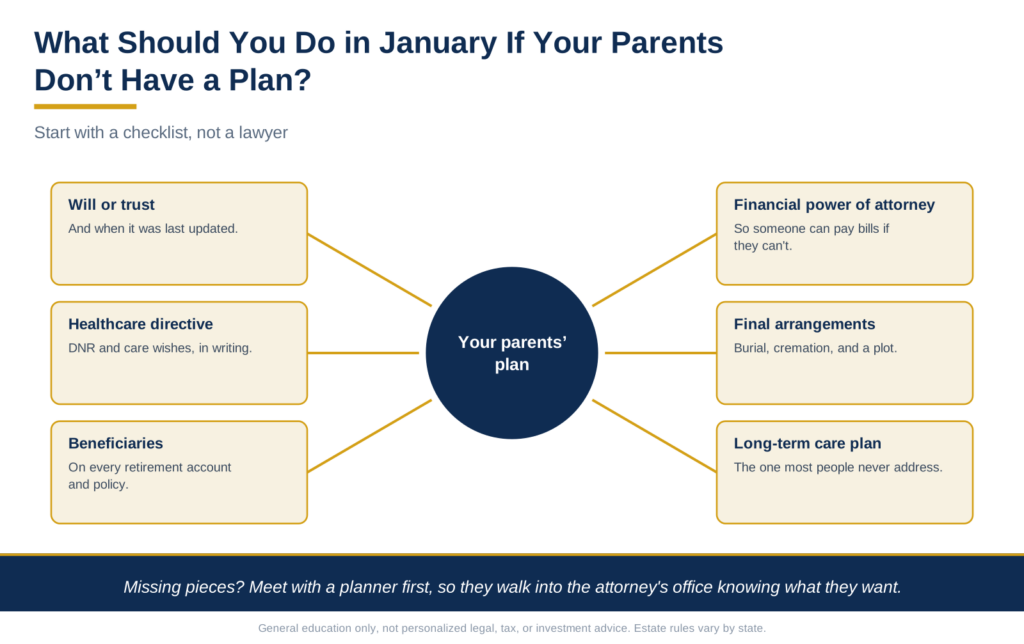
If they’re missing pieces, the next step is a planning meeting before the attorney meeting. A lot of attorneys won’t take the time to explain the options. At our firm, we run a full estate planning meeting covering wills versus trusts, the pros and cons of probate, and the ways to avoid it. Clients walk into the attorney’s office knowing what they want, which usually makes that meeting shorter and cheaper.
Ask one question this holiday season. Just one. “Do you know where your power of attorney paperwork is?” is a fine place to start. You don’t have to solve anything at the table. Getting the conversation started is the whole win.
If your parents need a second set of eyes on their plan, or you realize you need one too, let’s talk. Call (866) 626-3990 to schedule a complimentary meeting by phone, video, or in our office.

GREAT LAKES BENEFITS, INC. owns this website and provides SEC-registered investment advisory services. Registration does not imply SEC endorsement. This site offers general information, not personalized advice. Opinions are current as of posting and may change. Accuracy or timeliness of the content is not guaranteed. Past performance is not a predictor of future results. Consult your own legal or tax advisors before making decisions. Investing involves risks, including potential loss. No strategy ensures profit or prevents loss.
© Great Lakes Benefits Inc. ALL RIGHTS RESERVED. 2026. Privacy Policy | Disclosure . Powered by DevQ