
November 23, 2026
You might already be named in their documents. It’s better to find out now than in a hospital waiting room.
Most people in their 20s and 30s have no idea whether they’re in their parents’ plan. You could be the power of attorney, the executor, the healthcare decision-maker, or none of those. You don’t need to know what your parents have. You do need to know what you’re responsible for and where the paperwork is.
Knowing your role ahead of time keeps a hard moment from getting harder. When a parent lands in the hospital, families who never had the conversation end up scrambling. Is the will in a safety deposit box? At the attorney’s office? Which attorney? All of that gets figured out while everyone’s already stressed.
The scramble also causes fights. A family finds the documents mid-crisis and learns for the first time that one sibling was named and another wasn’t. Talking early means everyone hears it while your parents can still explain their reasons.
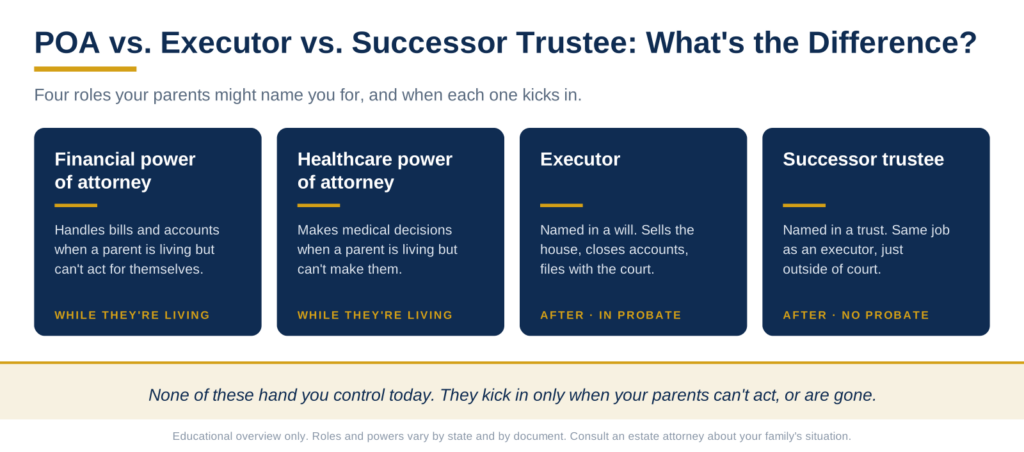
There are four common roles. Two apply while your parents are living and two apply after they pass. Each one is a different job, and a family can give each job to a different person.
| Role | When it applies | What the job is |
|---|---|---|
| Financial power of attorney | While your parent is living | Handling bills, accounts, and money decisions for a parent who can’t |
| Healthcare power of attorney | While your parent is living | Making medical decisions for a parent who can’t speak for themselves |
| Executor (named in a will) | After your parent passes | Settling the estate through probate court |
| Successor trustee (named in a trust) | After your parent passes (or if they can’t serve) | Settling the trust outside of probate court |
A power of attorney isn’t a blank check. Many are written to take effect only once your parent can’t make decisions for themselves, and some take effect as soon as they’re signed. The document spells out which one applies, so read it or ask the attorney who drafted it.
If you’re named executor, you’re the one who settles the estate. That can mean selling the house, closing or retitling accounts, distributing assets to the beneficiaries, and filing paperwork with the probate court. A judge oversees the process to make sure the will is followed.
A successor trustee does nearly the same job, just outside of court. Some people use a trust so their family can skip probate, which can cost money, take months, and become public record. There’s no judge signing off, so the successor trustee carries more of the responsibility themselves.
The way to prepare is simple: know what you’re responsible for. Find out where the documents are kept, which accounts exist and where, and who the attorney and planner are. You don’t need dollar amounts. You need a map.
One thing families miss is location. The child who lived ten minutes away when the will was signed may now live across the country. If nobody updated the documents, that child has to fly back and forth to settle the estate. That’s why documents should be reviewed every few years and after any big move.
The most common gap is having no backup. A married couple names each other as power of attorney and executor, which makes sense. But if both of them become incapacitated or pass away together, the documents don’t name anyone else. So the planning question is: you’re your spouse’s first choice, but who’s next if your spouse can’t do it?
Most parents already know the answer: usually the most responsible child, or the one most comfortable with money. Some families split the roles. A child with a nursing background might handle medical decisions while a sibling handles the finances, regardless of who’s oldest.
This is the situation most likely to go wrong. Say a couple has six kids between them, three from each prior marriage. They both expect everything to be split among all six eventually. Then the husband passes first and all of his assets go to his wife.
| What happens | Who ends up inheriting |
|---|---|
| Husband passes; everything goes to his wife | The plan still points to all six kids |
| His kids drift away for years; she updates her beneficiaries | Only her three kids |
| She remarries and names her new spouse | The new spouse, then whoever that spouse chooses |
His kids end up with nothing from their own father’s savings, and he had no way to stop it. Stale beneficiary forms do the same damage. A first spouse still listed on an account can inherit it ahead of the current spouse.
A his-and-hers trust can keep each spouse’s half going to the beneficiaries they chose. It tends to make the most sense for larger estates, often $1 million or more. The conversation can get uncomfortable, but it’s easier now than a fight between the kids later.
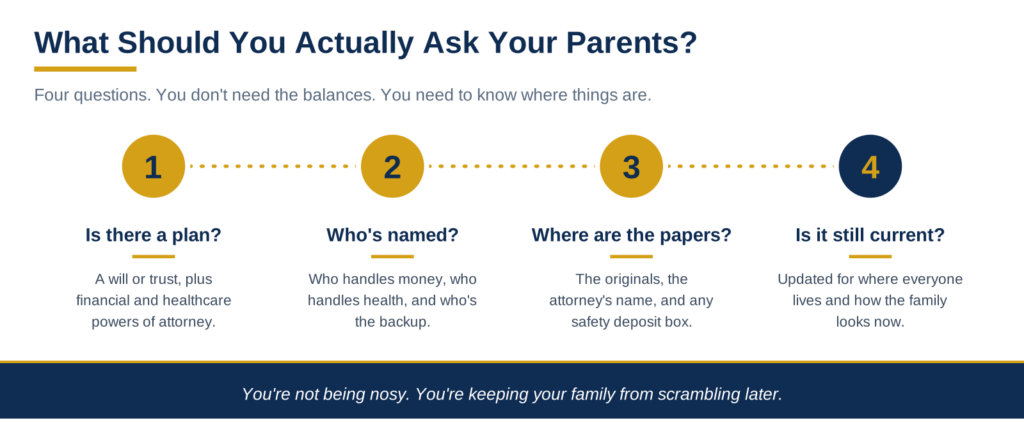
You don’t need to ask what they have. These questions are enough:
If your parents keep putting it off, keep nudging. Some people avoid it because thinking about it genuinely bothers them. You can’t force it, but you can remind them the plan is for the people they’d leave behind. Our guide to talking to your parents about money covers how to start that conversation, and the paperwork checklist lists what your family should be able to find.
Not much. Working with your parents’ planner makes an inheritance a little simpler. Accounts can be retitled to you at the same firm without being moved anywhere. If you already like your own planner, the money can move there just as easily.
Who you work with matters less than having your own game plan before the money arrives. An inheritance is easier to handle when it lands in a plan that already exists. If you’re starting from scratch, see what happens in a first financial planning meeting, or read how families pass on more than money in building generational wealth.
Ask one question this month: “Am I named in anything, and where are the papers?” That’s it. You don’t need the whole plan, just the first piece of it. Everything else gets easier once that conversation has started.
Want a second set of eyes? Schedule a complimentary meeting by phone, video-conference, or in our office. Call (866) 626-3990 or book a no-obligation discovery call.

GREAT LAKES BENEFITS, INC. owns this website and provides SEC-registered investment advisory services. Registration does not imply SEC endorsement. This site offers general information, not personalized advice. Opinions are current as of posting and may change. Accuracy or timeliness of the content is not guaranteed. Past performance is not a predictor of future results. Consult your own legal or tax advisors before making decisions. Investing involves risks, including potential loss. No strategy ensures profit or prevents loss.
© Great Lakes Benefits Inc. ALL RIGHTS RESERVED. 2026. Privacy Policy | Disclosure . Powered by DevQ